Course curriculum specialized
Index
Seminar 1 – Relational Touch
Explores the phenomena of touch, space, perception and Tidal forms. Looks at the craniosacral biodynamic concept in depth.
- The relational field
- Holistic shift
- Unfoldments of the Breath of Life
- Perceptual Fields
Starting to look at:
- Stillness
- Resourcing
- Patterns of Experience
- Inherent treatment plan
You will learn how to:
- Establish a state of balanced awareness and practitioner fulcrums
- Be able to achieve a settled state within your own system
- Negotiate the contact space with your client
- Be able to sit back and listen to how your client’s system is
- Establish a clear relational field
- Notice expressions of primary respiration in your own body and others
- Recognize stillness in yourself and others
- Invite systemic stillness in your client's system
- Offer a wide perceptual field
Seminar 2 – The Midline
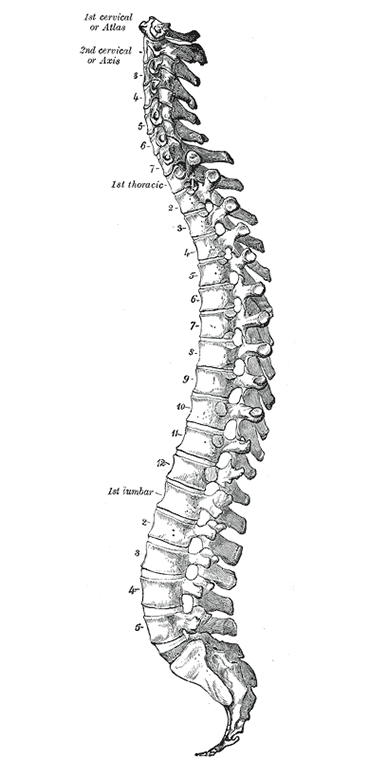
Explores the spine as a unit of function and natural fulcrum for the whole body’s health as well as a conductor for the primary energies of the bodymind system. Looks at how natural adjustments take place around this axis.
- Embryological origins
- Original health and blueprint
- Primal midline
- Holistic spine
- The two poles - sacrum and occiput
- Spinal motion dynamics
- Fluid spine
- Key Joints
Starting to look at:
- Natural states of balance
- Tissues, fluids and potency
- Body learning
- Recognising and treating trauma affects
You will learn how to:
- Recognize how the health of the spine affects the health of the whole body
- Become familiar with recognizing expressions from the primal midline.
- Listen to the spine as a whole unit of function.
- Relate to the health of the spinal curves and the continuity through the spinal column helping you identify spinal joint patterns.
- Recognize the horizontal relationships of the spine, that is, facilitated segments and irritability in visceral and somatic nervous arcs and how to meet them therapeutically.
- Learning skills of assessing your client’s health.
Seminar 3 – Whole Body Dynamics
Explores the phenomenon of holism. When the body communicates and moves as a whole, there is access to greater health. Looks at continuity of tissues, whole body patterns and shapes. Also looks at reciprocal motion through the body.
- Connective tissue
- The Fascial web
- Reciprocal motion in membranes
- Horizontal and transverse structures
- Whole body whole field
- Resolving whole body patterns
- Trauma models
- Hip and Shoulder Joints as key nodes in Fascial Web
- Wide perceptual fields and the Long Tide
- Practice development: skills of assessment, diagnostic baselines, language for touch, recording treatments
You will learn how to:
- Recognize how the health of the connective tissue matrix can affect the health of the whole system.
- Become familiar with assessing connective tissue health.
- Feel whole body patterns.
- Differentiate between longitudinal and transverse strains in the body - appreciating their convergence and inter-relationships.
- Recognize the qualities of dural membrane, being able to relate to the falx and tentorium as key structures for cranial health.
- Listen to the dural tube, observing dural glide as a way of assessing mobility.
Seminar 4 – Birth, Ignition and Original Health
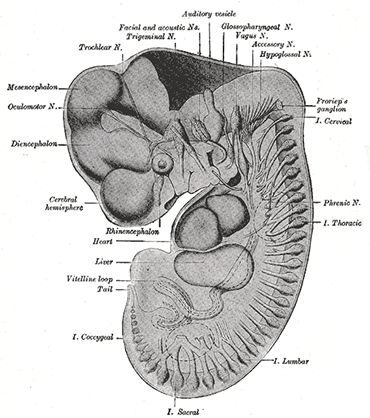
Explores how we develop in utero and the prenatal conditions for health. Craniosacral therapy can form a relationship to these early forces and facilitate a re-ordering of early affects. Looks at the process of birth and how the body shapes itself in response to this unique event.
- Pre-natal experience and the psyche
- Cranial base patterns and their resonance
- Whole body birth shapes and posture
- Understanding entrainment
- Ignition processes
- Attachment and bonding body affects
- Relating to the transpersonal
- Pacing and containment
- Practice development: developing trust in body intelligence, diagnosing health and assessing change
You will learn how to:
- Work with the vault hold (Sutherland’s hold) and modified vault hold (Becker’s hold) to explore cranial distortions.
- Work with whole body shapes and patterns, exploring links to the cranial base and perinatal events.
- Orient to the cranium as a fluid membrane bag, appreciating the effect of birth stages in distorting the fluid filled bag that is the baby’s cranium
- Start to get a sense of compression, side-bending and torsion patterns.(physiological strain patterns of SBJ)
- Start to get a sense of lateral and vertical shear patterns of the cranial base (non-physiological strain patterns of SBJ)
- Deepen your appreciation of Long Tide through relationship to a ‘horizontal’ perceptual field
- Deepen skills around facilitating resources, presence and understanding pacing and containment
Seminar 5 – Treating Mothers, Babies and Children
Pregnancy, birth and early life are profound and formative times. These first moments can determine many aspects of our health and nature that condition the rest of our lives. Craniosacral Therapy offers a profound understanding of these events and through a unique and deep contact with the human system can help the expression of the innate life force within each individual. To be able to use these skills effectively can help the development of the embryo, foetus, baby and mother.
- Mother and Baby Resonance
- Treating Mother and Baby for the first time after the Birth
- Health Expressions/Trauma Expressions in Mothers and Babies
- Postnatal Period and Changes that Occur
- Natural Labour
- Paediatric Conditions
- Labour Complications and the Medical Model
- Physiological Changes during Pregnancy
- Treating Pregnant Women & Acknowledging the Baby’s Presence
- Conditions that developed in the Antenatal Period
- Clinical practise
- Case taking of the Woman and Baby on the first visit
- Treating Mobile Infants
- Verbal Skill enhancement
- Skills for staying present
- Practitioner self care and the role of supervision in practice
You will learn how to:
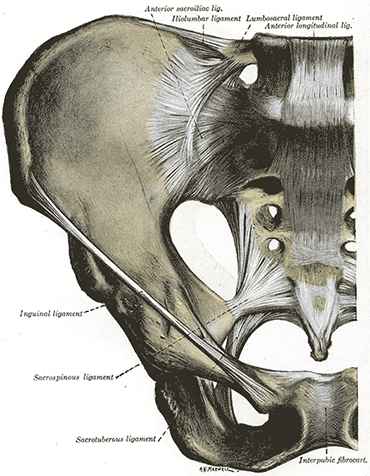
- Relating to the female pelvic anatomy
- Deepen your ability to create a relational field to include more than one person.
- Learn to work in short time frames and with limited contact.
- Appreciate factors which help create safety
- Enhance your trauma skills using both verbal and pacing skills.
- Review the ignitions of the body from a newborn perspective.
- Orient to the autonomic nervous system and appreciate its role in birth and bonding.
Seminar 6 – Visceral Intelligence
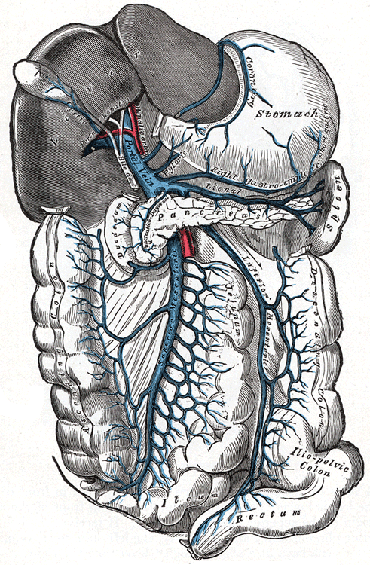
Explores how organs feel and move - their embryological origins and primary health expressions. Looks at how treatment can change their physiology in a profound way.
- Visceral nervous system
- Fight or flight response and the brain stem
- Limbic system and emotions
- Individual organ expressions and clinical considerations
- The gut and umbilical affects
- Physiological affects of stillness
- Practice development: acute and chronic conditions, dealing with serious illness, relationship with short, medium and long term clients
You will learn how to:
- Work precisely with the pericardium and its connection to other structures, especially the link between the cranial base and the diaphragm.
- Orient to the fluid nature of organs and the physiology of the body.
- Relate to the peritoneum as a visceral reciprocal tension membrane system.
- Sense of the gut tube and its particular, potency and movement expressions.
- Deepen your skills of listening form CRI and mid tide to body structures.
- Appreciate the integrative affect stillpoint has on organ physiology.
- Orient to body cavities as internal spaces.
- Understand the holistic nature of viscera, fluids, nervous system and potency.
- Deepen your skills of differentiation.
Seminar 7 – Bonding and Attachment
Babies teach us so much, reflecting back our skills of holding space in a definitive way. The deeper we hold presence for them and the original health blueprint, the more they show us the way. Deepening into practical aspects of biodynamic work with babies and their parents, understanding the anatomy and physiology of babies, the role and influence of cranial nerves on basic functionsand how to apply the polyvagal theory when working with babies. We will practice skills of working with babies and their caregivers, to support the family system and attachment process.
- Colic
- Acid Reflux
- Torticolis
- Plagiocephaly
- Feeding and nursing difficulties
- Tongue tie
- Disturbed sleep
- Food sensitivities
- Baby body language
- Practice development: being a successful fulfilled craniosacral therapist, how to survive as a self employed therapist
You will learn how to:
- Supporting the health of the digestive system of babies
- Understanding suck swallow breath coordination for breastfeeding
- Supporting homeostasis in the body through pineal gland potency
- Support babies and moms when there are difficulties in breastfeeding
- Work with cranial nerves of the social nervous system to improve vagal tone in babies.
- Practice skills to hold a wide field of perception for babies and parents enhancing sensitivity and perception

Seminar 8 – Neural Matrix
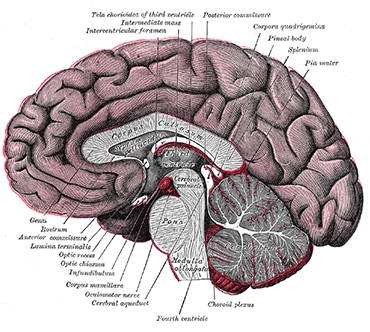
Explores the fluid/electrical phenomenon of the central nervous system right at the heart of us. In particular how the brain feels and responds to light touch. Looks at how to relate to neural patterning to bring about smoother neural flow dynamics.
- The whole brain
- Neural flow
- Ventricles and deep potency reservoirs
- Blood and brain
- Brain states
- Nerve facilitation
- Psycho-neuroimmunoendocrine response
- Stillness in the central nervous system
- Sea of stillness
- Practice development: being a successful fulfilled craniosacral therapist, how to survive as a self employed therapist
You will learn how to:
- Feel the ventricles of the brain and the deep potency that resides there. Following the potentization in the ventricles during stillpoint.
- Recognise how the health of the third ventricle can affect the health of the whole system.
- Become familiar with nervous tissue expressions of health. Learning to recognise states of balance and work with different parts of the brain, including the eye.
- Relate to venous sinuses. Assessing their freedom of movement and encouraging greater mobility and flow, potency and movement expressions.
- Identify brain stem activation and how to tone down the nervous system.
- Relate to the hypothalamus and pituitary and detect endocrine changes in the body.
Seminar 9 – Primitive Reflexes
Most people are aware of the lifelong autonomic reflexes like blinking, sneezing, coughing and withdrawing from nociceptive stimulus etc. We notice them because they part of our day to day physiologic function, and they feel natural (even if some aren’t pleasant). They feel natural as they are integrated into our sensory-motor system as a way of our body maintaining balance in the face of internal and external demands. However, many people are unaware that there are often more rudimentary unintegrated reflexes running in the background which can compromise function and limit the expression of an individuals health. These are the primitive reflexes which haven’t integrated into the wholistic development and function of the body.
- Cranial nerves & special senses
- Motions and emotions of the face
- Moro reflex
- Rooting reflex
- Emotional entrapment and its expressions
- Shock and the jaw
- The pivot of the throat
- Sucking reflex
- Pamar grasp reflex
- Assymetric tonic neck reflex
- Galant reflex
- Trauma affects and reflexes
- The empathetic practitioner
- The power of acknowledgement and non-action
- Practice development: framing the physiology of emotion and pain, developing presence and simplicity in the treatment session
You will learn how to:
- Recognize primitive reflex patterns
- Recognize cranial nerve patterns for facial and throat expressions of health and trauma
- Understand how the body processes through its reflexes
- Work with naturally arising reflexes
- Watch body posture and mobilization
- Become more precise in your ability to name patterns of expression and their quality and direction
- Define BCST through the spoken and written word
Seminar 10 – Cellular Intelligence
Looks at how the body is holistic in its very nature. The nervous system, the endocrine system and immune system are intricately linked and complementary, co-influencing our emotional and psychological states. New biology and new science will be examined as theories to help us understand what lies behind physical and emotional conditioning along with practical ways to bring this knowledge into the treatment room and meet your clients system in a truly holistic way.
- The phenomenon of the hypothalamic-pituitary-adrenal (HPA) axis
- Metabolic fields and the thyroid
- Immune system potency and the immune organs
- The hormonal molecular fluid matrix
- Regulation of the neuroendocrine immune system
- Understanding the stress/inflammatory response
- Practice development: building your practice, legal requirements, ongoing development
You will learn how to:
- Feel the HPA axis and be able to assess its level of biodynamic health and stress response
- Recognise how the potency connection of the third ventricle is pivotal for the health of the whole system.
- Become familiar with the immune response and its expression of health. Learning to work with the immune organs.
- Relate to the lymphatic ducts. Helping to free them and encouraging greater mobility and flow, potency and movement expressions.
- Learning to identify the pineal gland as a fulcrum for natural balance and rhythm.
- Relate to the body at a molecular level.